Insta360 X6: 8K 360 camera with 1-inch-class sensors
The 360 camera's oldest problem is arithmetic: an "8K" 360 recording sounds enormous until you remember it's stretched over a full sphere, and the flat 16:9 clip you actually export is a modest crop of it. Every generation of these cameras is a fight to push enough pixels — and enough light — into that sphere. The Insta360 X6, announced August 12, is the most serious attempt yet at the light half of that fight.
The specs, decoded
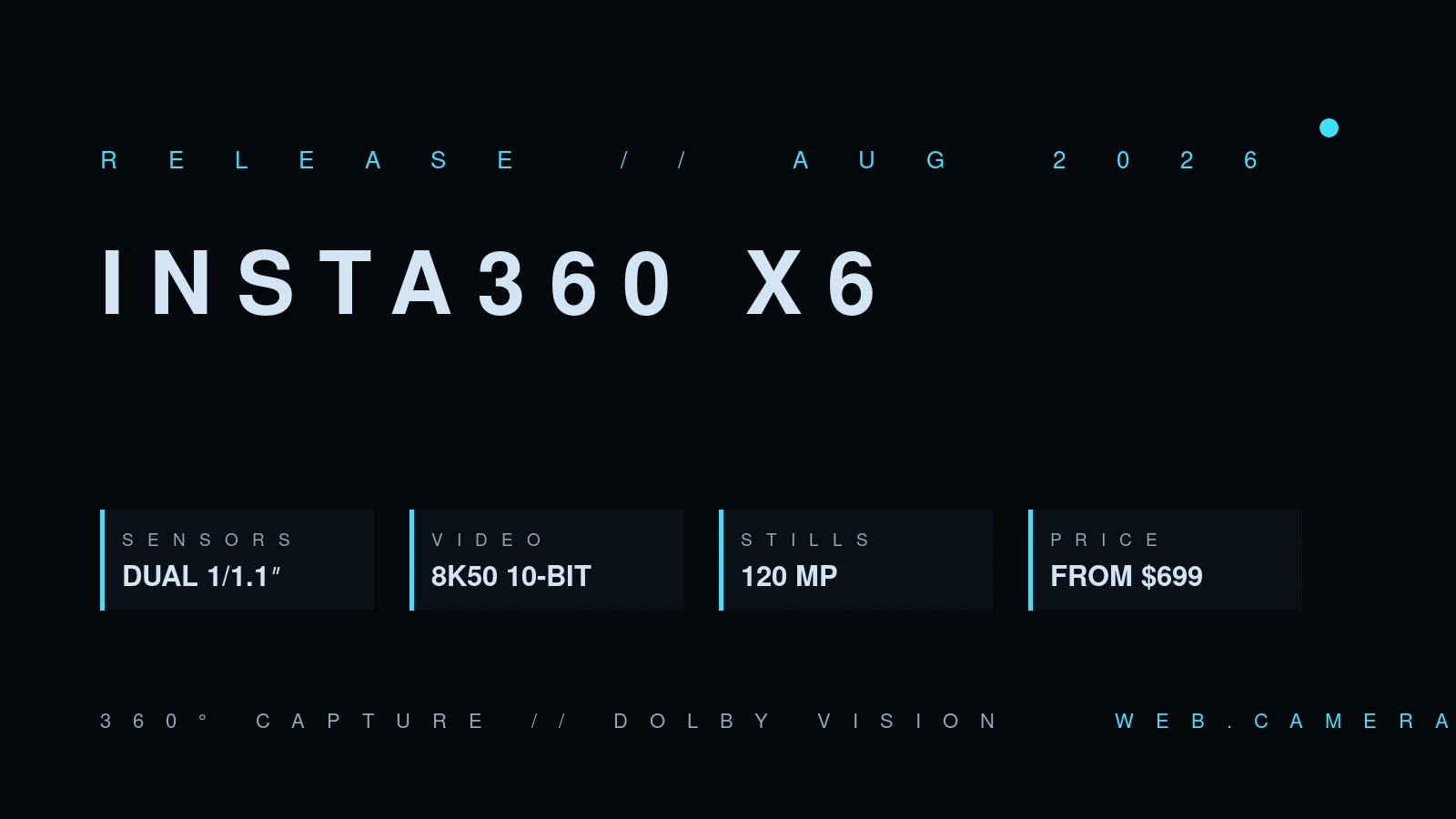
The headline is the sensor pair: custom dual 1/1.1-inch square Sony sensors, 42 MP each. Insta360 quotes 33% more sensor area than the X5 and roughly four times the light intake per frame; DPReview's coverage confirms the shape matters as much as the size — a square sensor wastes nothing when the lens projects a circular fisheye image onto it, where a conventional rectangular sensor crops the circle.
Feeding two 42 MP sensors is a triple-chip design — an 8-core 3.3 GHz processor plus two dedicated imaging chips, which Insta360 rates at five times the X5's compute. That budget goes to:
- Native 8K at 50 fps in 360 — previous generations recorded 8K at 30 fps.
- 10-bit color with in-camera Dolby Vision, a first for the category.
- 120 MP 360 still photos from the combined sensors.
Pricing starts at $699.99 (Standard bundle; $799.99 Essentials), available since launch day.
What 8K50 actually buys you
For a 360 camera, resolution is reframing headroom. You record everything, then "point the camera" in the edit — and your exported flat view uses only a fraction of the sphere's pixels. At 8K spherical, a standard flat export finally lands comfortably above 1080p with detail to spare, which is the difference between "neat gimmick" and "usable primary camera." The jump from 30 to 50 fps matters for the same footage: smoother motion in the crop, and more latitude for slow-motion in bright light.
The bigger sensors address the category's other embarrassment — indoor and evening footage. Small-sensor 360 cameras fall apart in dim light for exactly the reasons any small camera does (the same physics behind webcam frame-rate drops in low light); a 1/1.1-inch pair is the same sensor class as premium webcams' single sensor, doubled.
The webcam angle
Less advertised: like its predecessors, Insta360's cameras can operate as a USB webcam, and a 360 camera doing webcam duty is a genuinely different tool — it can frame any direction, or auto-track a presenter walking around a room, with no gimbal. An X6 is obviously not a $700 webcam purchase; but if the camera earns its keep filming rides and trips, its desk trick is real. If a call camera is what you actually need, our 2026 webcam roundup is the sane shopping list — and either way, the browser test will show you exactly what any camera delivers over USB.
The practicalities the launch posts skip
Native 8K50 in 10-bit produces enormous files, and the pipeline downstream has to survive them: fast (and large) storage cards, real transfer time, and an edit machine that can handle 8K spherical footage — reframing 360 video is one of the heavier editing workloads a consumer app performs, even with Insta360's software doing the lifting. Battery life is the other perennial 360-camera constraint; Insta360 claims improved endurance from the more efficient 4 nm silicon, and the launch coverage generally treats it as competitive rather than transformative. None of this is a criticism unique to the X6 — it's the tax every 8K camera charges — but "from $699.99" is the entry fee, not the total cost of actually using the resolution.
Against the rest of the market, the X6's pitch is straightforward: it moves the category's two weakest specs (sensor size and processing headroom) at once, while the main competition iterates on software. For a category that lives or dies by how good the cropped output looks, that's the right pair to move.
Should anyone upgrade?
From an X4 or earlier: the 8K50 + 10-bit + sensor jump is the generational leap that finally makes exported flat footage stand next to an action camera's. From an X5: the honest answer is "for low light and Dolby Vision, or not yet" — the X5 remains a very capable camera, and generational FOMO is expensive in a category where the software (reframing, stitching, stabilization) keeps improving for older bodies too. First-time buyers weighing the X6 against a conventional action camera should ask one question: will you actually reframe in the edit? If yes, nothing flat competes; if no, you're paying the 360 tax — file sizes, stitch lines, workflow — for a feature you'll skip. And as with every launch, spec-sheet numbers are claims about the hardware's ceiling, not the delivered result — the reason we keep measuring real camera output instead of quoting boxes.