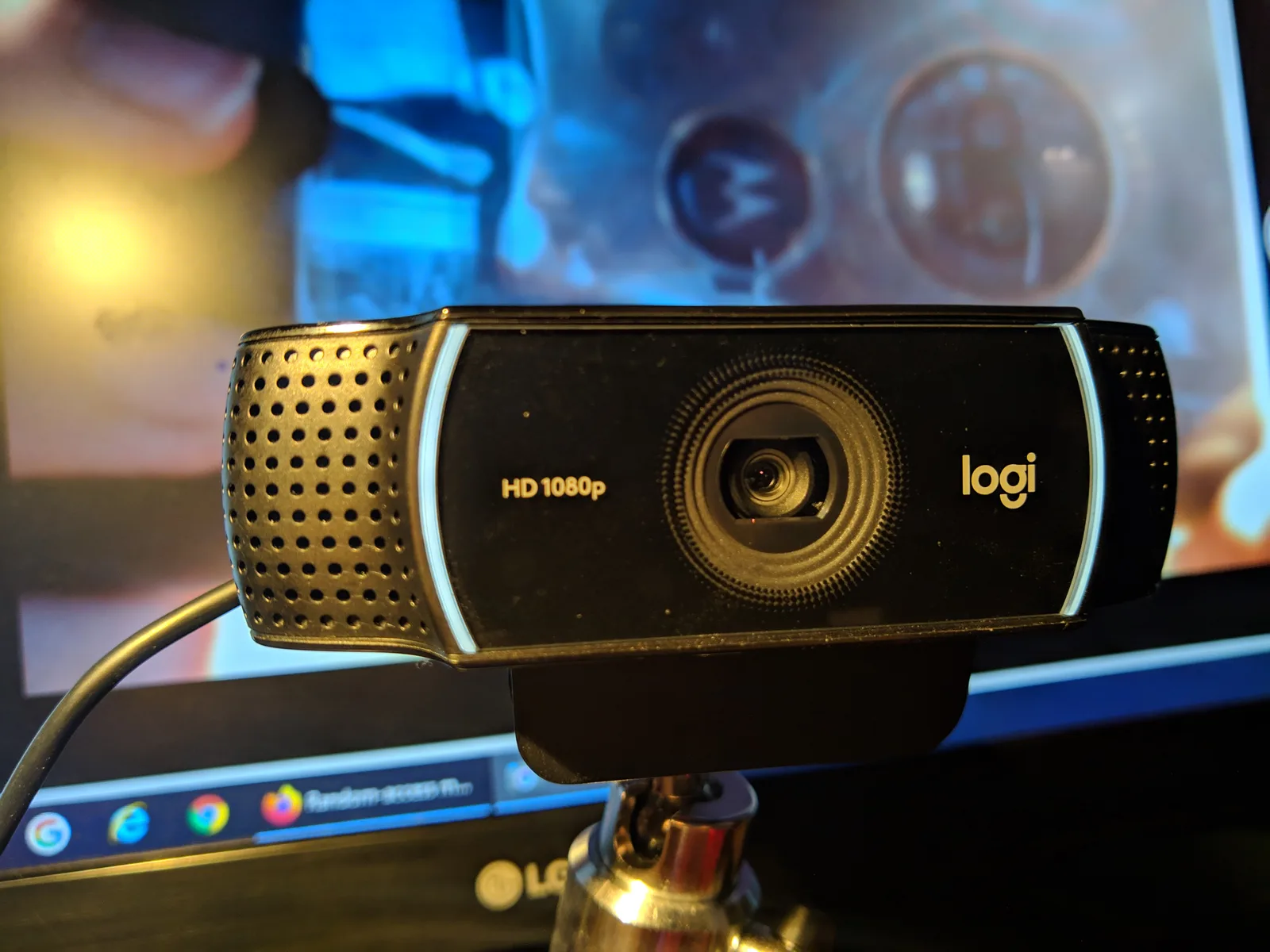
Best budget webcams under $50: what specs to expect
The under-$50 webcam market is where spec sheets get creative. "Full HD 1080p" can mean a sharp 1080p sensor behind a decent lens, or a 720p-class sensor upscaled in firmware behind a piece of plastic. The price tells you less than usual — so here's what the money actually buys, and how to check.
What $50 realistically gets you
- Resolution: honest 1080p30 exists at this price, but it's not guaranteed. 60 fps claims under $50 are usually 720p60, or 1080p60 that collapses in normal room light.
- Sensor: small — 1/4-inch class is typical. This is the real constraint: small sensors mean visible noise indoors and the evening frame-rate drop we explain in why webcam FPS drops in low light. No budget webcam escapes it; some hide it better than others.
- Optics: fixed-focus is common below $30. Fixed focus is honestly fine at conversation distance — it removes focus-hunting, the most annoying webcam failure mode.
- Mics: built-in, mono or basic stereo, and universally mediocre. Budget for a headset, and test whichever mic you use.
- Extras that do show up: physical privacy covers have trickled down to sub-$30 models, and they're worth having — see our webcam privacy checklist.
Current picks
Logitech C270 / Brio 101 (~$20–25). The C270 has been the default cheap webcam for over a decade — 720p30, fixed focus, reliable auto light correction, drivers that never break. The Brio 101 is its modern successor at a similar street price with a 1080p sensor. Boring in the best possible way, per TechRadar's budget testing.
EMEET C950 (~$20). Honest 1080p with a physical privacy cover at C270 money. The value pick if you want 1080p at the absolute floor.
NexiGo N60 (~$30). The pick when you need a wider view: a 110° field of view (most webcams sit near 60–80°), useful for showing a workbench or fitting two people in frame. Solid cross-platform behavior.
Anker PowerConf C200 (~$60, the "spend slightly more" pick). Just over the line, but it buys the one spec this price class lacks: a 1/2-inch sensor, roughly four times the area of the typical budget module. If your room isn't bright, this is where the extra $25 goes furthest — it addresses the actual weakness rather than the number on the box.
The used-market wildcard: Logitech C920 (~$25–40 used). The most-measured webcam in existence, honest 1080p30, glass optics, autofocus. There are millions of them; you can see how the C920 and its siblings perform across real sessions in our camera database.
Decoding the box: what budget specs really mean
A translation table for the claims you'll meet at this price:
- "Full HD 1080p" — the sensor's pixel grid, not a promise about sharpness. Behind a plastic lens, 1080p capture can resolve less real detail than a good 720p module. Delivered results are what matter, which is why measured medians beat spec sheets.
- "Autofocus" — at conversation distance, fixed focus set to ~0.5m–infinity is just as sharp and never hunts. Don't pay extra for AF on a camera that will sit 70 cm from your face; it mostly matters for holding objects up to the lens.
- "AI-enhanced" / "beauty mode" — firmware smoothing and face brightening. It can't add detail the sensor didn't capture, and aggressive versions produce the plastic-skin look. Neutral processing ages better.
- "Wide angle" — check the number. 60–78° frames one person; 90–110° fits two people or a demo bench but makes a lone face small and shows more of your room (and more of it needs to look presentable).
- "Built-in dual mics" — present, functional, and still the wrong distance from your mouth; the physics is covered in why webcam microphones sound bad.
- "60 fps" — believe it only at 720p, in good light. In a normal evening room, every small sensor drops frames to keep exposure up.
How to not get burned
Whatever you buy, verify it delivers what the box claims: plug it in and run the browser webcam test — it reports the true negotiated resolution and frame rate, in your actual room light, in under a minute. If a "1080p" camera hands the browser 640×480, back it goes.
And calibrate expectations: the jump from a laptop's built-in module to any competent $25 external camera is the biggest quality-per-dollar move in this entire market — the measurements in laptop vs external webcam back that up. Everything above $50 is refinement; the first $25 is transformation.
Finally, spend the money you saved where it multiplies: a $15 clamp light bounced off the wall behind your monitor will do more for a $25 webcam than a $100 camera upgrade would, because light is the input every small sensor is starving for. Budget camera plus deliberate light beats expensive camera in a dark room — that ordering is the most consistent pattern in webcam picture quality, and it's free to test tonight.